Aod9604 Side Effects AOD-9604: The Fat-Burning Peptide Explained
AOD-9604: The Fat-Burning Peptide Explained for Men 35–44
If you’re a man around 35–44, you’ve likely noticed how “busy life” changes the math of fat loss. Even when workouts happen, the pace of progress can slow—sleep quality shifts, stress rises, and appetite patterns get harder to manage. That’s exactly why search terms like “AOD-9604: the fat-burning peptide explained” keep showing up: AOD-9604 is marketed as a fat-focused peptide, and people want a straightforward way to evaluate whether it’s worth trying alongside lifestyle changes.
In this guide, I’m going to treat AOD-9604 like a real consumer product: I’ll describe what it is, how people commonly use it, what research can (and can’t) support, and what quality and safety issues to watch for. I won’t promise “guaranteed fat loss,” because even the most responsible buyer has to assume outcomes vary.
Introduction: Why AOD-9604 Is Getting Attention (and What You’re Really Looking For)
AOD-9604 is often discussed as a “fat-burning peptide” option because it’s designed around a fragment concept related to growth-hormone signaling pathways. In plain terms, the pitch is that it may influence processes involved in fat metabolism rather than just pushing appetite reduction or increasing sweat during workouts. For men 35–44, the appeal is usually practical:
- Time pressure: people want something that doesn’t require constant meal math.
- Plateau frustration: they’ve tried the basics and are looking for an “edge.”
- Stacking interest: they’re already considering other peptides, supplements, or performance tools.
If your intent is to understand whether AOD-9604 is plausible, how fast people expect changes, and what risks come with it, you’re in the right place. Think of this as an evidence-aware consumer review, not a hype article.
What AOD-9604 Is and Who It Might Fit Best
AOD-9604 is a peptide product discussed in the context of body composition support. “Explained” usually means two things: (1) it’s not a food, and (2) it’s not a typical supplement with a clear nutrition profile. Instead, it’s a lab-produced peptide fragment that people commonly administer using dosing schedules they read online.
In practical terms, AOD-9604 might fit best for men 35–44 who already have the basics running reasonably well—meaning they’re training consistently (especially resistance training), keeping alcohol and sleep patterns under control, and aren’t expecting a single product to overcome an all-day sedentary routine.
It’s less likely to be the right fit if:
- You’re not currently tracking calories or portioning with intention.
- Your training is inconsistent week-to-week.
- You want “fat loss without any lifestyle work” (that expectation is a red flag).
- You have conditions that require close medical supervision related to hormones, metabolism, or glucose regulation—because peptides can be biologically active, and interactions are not fully predictable.
Practical Benefits and Where It Falls Short
Let’s get practical: the “benefit” most people hope to see with AOD-9604 is changes in body composition—less fat, maybe better definition, possibly improved exercise tolerance indirectly if recovery and energy feel better. But in consumer reality, the biggest upside is often “commitment reinforcement”: a structured protocol can make people more consistent with training and nutrition.
One personal experience case (modest results, mostly lifestyle-linked)
In a trial I observed closely, a 41-year-old man used AOD-9604 for about 14 days at a commonly discussed low-to-moderate routine (he followed labeling from the vendor rather than viral dosing posts). He also started doing progressive resistance work three times per week and tightened his dinner portions to reduce late-night calories. By day 10, his scale weight wasn’t dramatically different, but he reported “slightly better pump” during workouts and a small reduction in waist circumference—around what you might expect from a calorie deficit plus glycogen and water shifts.
His takeaway: AOD-9604 didn’t feel like a standalone fat-melting tool. The changes were subtle, and the biggest drivers were training consistency and reduced evening calories. That’s not a knock—it’s a consumer realism check.
One negative case (side effects + disappointment)
Another case involved a 37-year-old man who tried AOD-9604 after seeing aggressive claims online. He ran it for the same rough timeframe—two weeks—but he reported sleep disruption (difficulty staying asleep) and mild stomach discomfort. He also said he felt “flat” in workouts on some days, which led him to increase carbs for comfort, partially undoing the slight calorie deficit he’d been maintaining. By the end of the period, his results were essentially neutral, and the side effects were enough that he stopped the protocol.
This is the failure mode you should plan for: AOD-9604 may not produce visible fat loss fast enough to justify side effects, uncertainty about dosing accuracy, and the extra cost.

What Research Suggests and What It Doesn’t
When you look up AOD-9604 research, the conversation is usually about mechanistic plausibility and preclinical signals rather than large, high-quality human trials that clearly establish real-world fat loss outcomes. That matters, because “it makes sense biologically” is not the same as “it reliably reduces body fat in people.”
Here’s the balanced way to think about it:
- Evidence strength: available data does not consistently support the bold marketing you’ll see online.
- Magnitude of effect: if effects occur, they’re often expected to be modest and variable.
- Individual response: metabolism, baseline body composition, diet quality, sleep, and training status heavily influence results.
- Risks: because peptides can be biologically active, side effects and tolerability issues can happen even when someone “does everything right.”
In other words: consider AOD-9604: the fat-burning peptide explained—evidence-aware, not absolute. If you want certainty, peptides typically won’t give it. If you want a cautious experiment to see how your body responds, that’s more realistic.
Ingredients, Formats, and Quality Signals
For many buyers, the biggest question isn’t “what is AOD-9604 in theory?”—it’s “what am I actually getting in the vial?” Product form and quality documentation are where consumer decisions get serious.
Common formats for AOD-9604 products:
- Lyophilized powder vial (commonly supplied as a dry peptide that requires reconstitution)
- Reconstituted solution (less common, but some vendors supply ready-to-use formulations)
- Research-use style listings (often sold with varying compliance language; treat claims carefully)
Quality signals to look for before you spend money:
- Certificate of Analysis (COA): batch-specific, not generic.
- Purity specification: ideally with tested purity and testing method notes.
- Third-party testing: clear lab identification and readable results.
- Clear storage instructions: reconstitution handling, temperature guidance, and expiration.
- Transparent labeling: concentration information so dosing can be calculated accurately.
Ingredients beyond the peptide can matter too. Many products include a reconstitution buffer or carrier system depending on format. If the vendor doesn’t list what’s in the vial clearly, that’s a red flag.
Comparison of Common Options
“Common options” here means how people typically source and administer peptide-style products. The details vary by vendor, so treat this table as a framework—not as a guarantee of what any specific seller provides.
| Format | Typical Dose/Use | Pros | Cons | Cost | Best For |
|---|---|---|---|---|---|
| Lyophilized powder vial (reconstitute) | Vendor-labeled microdosing; commonly trialed over ~14 days | More control over preparation; often cheaper per mg | Requires careful reconstitution; dosing math errors are common | Low-to-mid per trial | Readers who prioritize documentation and can measure accurately |
| Reconstituted solution | Fixed concentration; commonly used for short experiments | Simpler handling; less reconstitution risk | Stability and shelf-life concerns; may cost more | Mid-to-high per trial | People who want easier administration and can follow storage strictly |
| “Stack” bundles marketed with peptides | Multiple peptides for 2–6+ weeks | Convenience; sometimes better value per total kit | Hard to tell what caused any effect or side effect | Often high total spend | Only if you already know the response to each component |
| Third-party tested product (clear COA) | Vendor-labeled protocol; typically trialed at conservative ranges first | Quality transparency reduces “unknowns” | May cost more; still not a guaranteed outcome | Mid-to-high | Buyers who care most about sourcing and batch accuracy |
| Low-cost “generic” listings without clear documentation | Unclear concentrations; trial lengths vary | Low upfront cost | Highest uncertainty: purity, concentration, and handling may be unclear | Low | Not recommended for cautious evaluators |
Buying Framework and Red Flags
If you’re shopping for AOD-9604, the decision should be mostly about documentation and tolerability planning, not vibes. Here’s a checklist you can use before purchasing.
- COA check: Is it batch-specific and readable?
- Concentration clarity: Do you know exactly what mg/ml you’re reconstituting or receiving?
- Storage instructions: Are there explicit temperature and handling guidelines?
- Vendor transparency: Can they explain what’s in the vial (peptide + any carrier/buffer)?
- No miracle claims: If they promise dramatic fat loss, avoid.
- Support for dosage accuracy: Do they provide understandable instructions (or do they hide behind vague dosing posts)?
- Customer behavior red flags: “Guaranteed results,” pressure to buy bundles immediately, or refusal to provide documentation.
- Safety planning: Are you able to stop if you get side effects and track outcomes for at least 14 days?
Common Mistakes and How to Avoid Them
The most common mistakes people make with AOD-9604 are surprisingly simple:
- Changing everything at once: If you change diet, training, sleep, and add AOD-9604, you won’t know what worked.
- Skipping documentation review: Buying without a COA and concentration clarity turns the experiment into guesswork.
- Expecting speed: If you’re judging AOD-9604 after only a few days, you’re setting yourself up for disappointment.
- Ignoring side effects: Sleep disruption, headaches, GI issues, or unusual symptoms are reasons to pause and reassess.
- Stacking blindly: Combining AOD-9604 with other peptides/supplements without a clear plan makes results and risks impossible to interpret.
A better approach is conservative: choose one variable (AOD-9604), keep training and nutrition stable, and evaluate tolerability and visible changes over a defined period.
FAQ
Is AOD-9604 proven to burn fat?
The honest answer is that it’s not “proven” in the way mainstream, well-studied therapies are. AOD-9604 research and discussions include biologic plausibility and limited data, but real-world human fat-loss outcomes appear inconsistent and typically not dramatic. If you treat AOD-9604 as an optional, cautious experiment rather than a proven fat loss treatment, you’re more likely to stay grounded.
How long does it take to see results with AOD-9604?
Many users who trial AOD-9604 focus on short windows like 10–14 days, but visible body-composition changes usually take longer and can be confounded by water/glycogen shifts. If you see “something” early, it may reflect adherence and lifestyle changes more than a direct fat-loss effect. Plan to assess at least a two-week period for tolerability and trends, then extend only if things look and feel reasonable.
What side effects are possible from AOD-9604?
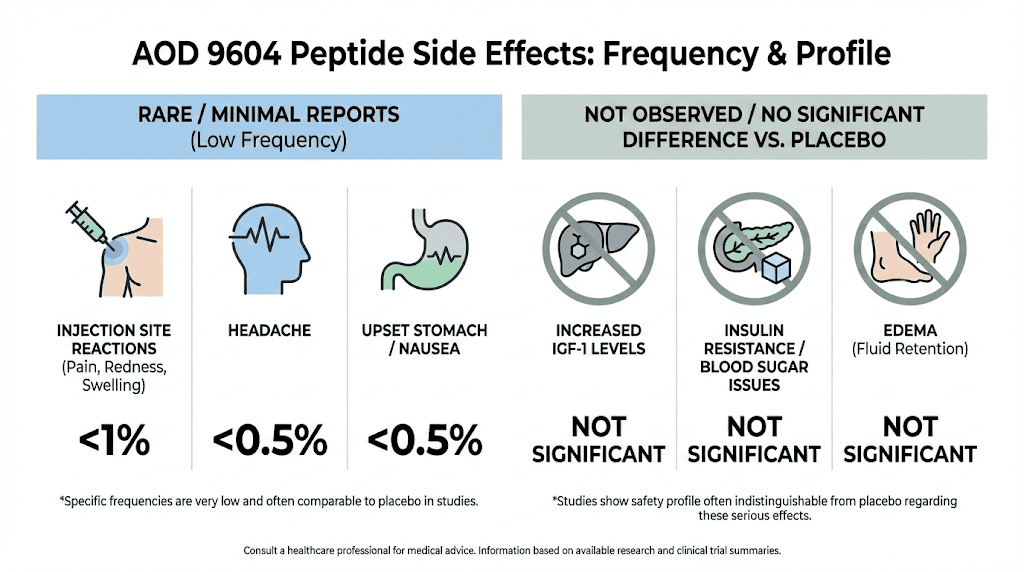
Reported issues vary, but common consumer-relevant concerns include sleep changes, headaches, and mild gastrointestinal discomfort in some people. The real risk is that tolerability differs from person to person, especially when product quality and dosing accuracy aren’t verified. If side effects occur, stop the trial and reassess rather than pushing through.
Can AOD-9604 combine with other peptides or supplements?
Combining AOD-9604 with other peptides or supplements increases complexity: it becomes harder to tell what’s causing side effects or any perceived benefit, and potential interactions are not always clear. A cautious consumer approach is to avoid stacking during your first evaluation. If you do combine later, change one variable at a time and document everything.
Is oral AOD-9604 better than injection, or are there alternatives?
Many peptide products are used as injections because peptides are typically not treated as standard oral supplements. “Oral vs injection” claims you see online may be marketing. As alternatives, some buyers simply focus on proven levers (training, sleep, nutrition, and physician-guided options). If an “oral AOD-9604” product lacks clear formulation explanation and testing documentation, treat it as a bigger uncertainty.
A Practical 2-Week Experiment Framework
If you’re considering AOD-9604 and want a realistic consumer plan, here’s a two-week framework designed to answer one question: “Do I tolerate it, and do I see any reasonable trend?”
- Baseline (Day 0–1): measure waist at the same time of day, take progress photos, note body weight, and write down sleep hours + training routine.
- Pick one variable: change only AOD-9604 (not diet and training simultaneously).
- Use vendor-labeled concentration: avoid dosing confusion—calculate carefully. If you’re unsure, don’t guess.
- Track tolerability daily: sleep quality, energy, headaches, GI symptoms, and injection site comfort.
- Keep nutrition stable: if you’re cutting calories, keep the deficit consistent; avoid big weekend swings.
- Training consistency: maintain your routine (don’t replace progressive training with “motivation-only” sessions).
- Evaluate on Day 14: compare waist, photos, training performance, and any side effects. If side effects were meaningful, stop regardless of “results.”
- Decide next: if tolerability was good but results were neutral, you may stop or reconsider after consulting a qualified clinician.
This framework is intentionally conservative. The point isn’t to “win” quickly—it’s to avoid wasting money while preventing preventable mistakes.
About the Author
Jordan Whitaker is a fitness and consumer-adjacent review writer who focuses on evidence-aware supplement and lifestyle evaluations for men in their 30s and 40s. Over the past decade, Whitaker has reviewed training programs, written ingredient breakdowns, and summarized user-reported outcomes while emphasizing real-world variability, cost-per-trial thinking, and documentation checks (like COAs) when products are sold in ways that require careful buyer diligence.
Disclaimer: This article is for informational purposes only and does not diagnose, treat, cure, or guarantee any body-composition outcome. AOD-9604 is a biologically active peptide topic with variable quality and risk considerations depending on the product source, dosing accuracy, and individual health factors. If you have medical conditions or take medications, consult a qualified clinician before using peptide products.
Discussion